Nevermind The Posers

See ya in the pit.

Gonzo: The Life of Hunter S. Thompson by Jann Wenner & Corey Seymour October 8, 2010

Filed under: Book Reviews — NVMP @ 7:05 AM
Tags: ,

A Review by Alexander Stigz CastiglioneDriving around South America with a spider monkey in his pocket, stinking up the car with rum-drenched monkey vomit…Nailing a pig heart to Jack Nicholson’s front door while blaring a recording of animals dying from a boom-box in the woods…Throwing an IBM Selectric typewriter out the window and firing a few .44 caliber rounds in it.
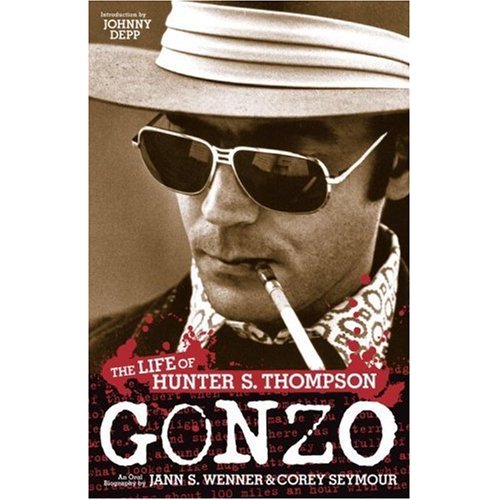
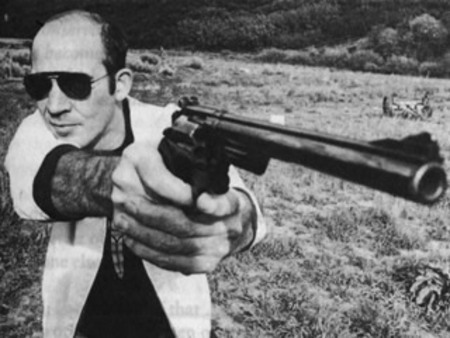
Off color?  Definitely.  Madness?  Maybe.  Hunter S. Thompson doing all of this?  Absolutely.

And those stories are only the beginning of a life steeped in booze, sex, drugs, and the American Dream.  Gonzo takes these stories, climactic and wild as they are, and presents them in such a way that you close the book, actually feeling like you knew Gonzo himself.

Thompson fired literary bullets with fury and precision, much like the machine gun of the same name; belt fed on a diet of drug and a menu of madness, Hunter Thompson “shot out of the womb angry, and left in exactly the same way.”  This biography written by two of his colleagues at Rolling Stone magazine truly illustrates the eccentricity and enigmatically magnetic man who Hunter S. Thompson was.  In the form of an oral biography, they talked to hundreds of his friends, family, colleagues and acquaintances.  From his wife, to actors Johnny Depp and Jack Nicholson, all the way to his fellow writers at Rolling Stone, the book tells a story from every conceivable angle.  Some thought he was a genius, others thought he was a prick; the beauty is that the book let’s you decide.

And it does this by being filled with wonderful little nuggets of information that most people in my generation wouldn’t know.  Did you know Thompson ran for Sheriff of Denver?  He actually got pretty close to winning.  How about how the writer of Fear and Loathing in Las Vegas spent his free time?  Yes, that’s right, shooting at gas cans and propane tanks at Owl Farm when he wasn’t writing insane and incisive contemporary literature.  What was a “Hunter Breakfast”?  A six-pack of Heineken, half a grapefruit, a hard-boiled egg, and a few joints of some primo Thai stick.  For lunch?  A little LSD here, some burgers there, and some booze everywhere.
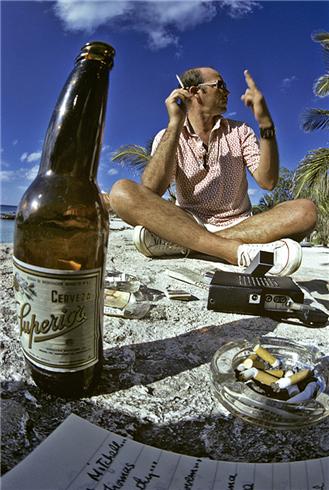
There are extremely too many stories in the piece to even begin to touch upon all of them, and several times, I was laughing so hard, people were looking at me like I was tripping on acid myself.  From the Christmas cards he sent out to friends and family that said “Ho!Ho!Ho!  I shit down your chimney! – Hunter” to his sexual conquests, all the way to his prolific and infamous drug use, it is the understatement of the century to say Gonzo lived “an interesting life.”  But it doesn’t key in on these things specifically.  I don’t know about you, but I didn’t think the Fear and Loathing author possessed, as one story-teller put it, “the keenest political mind” he had ever encountered.  He rubbed elbows with Presidential candidates, actors, musicians, drug dealers, and bikers alike, something extremely rare for an artist/writer in any period in history.

Some parts of the book drag on, while others you’re flying through, reading fifty or sixty pages before you realize it.  Overall, the wildly outlandish stories outweigh the mundane little tidbits about his home life/work ethic/family.  Stick with it, and you will be laughing your ass off.

One thing is for sure: Still waters may run deep, but the raging rapids of Thompson’s life are vastly more interesting.  Read the book.

4/5 Tabs of Acid


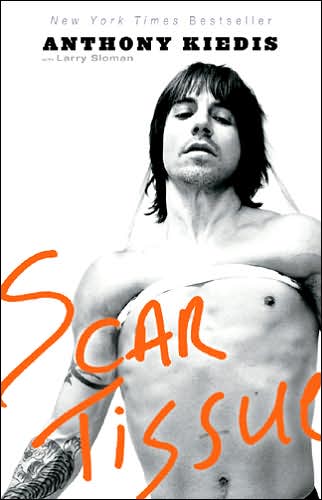
Scar Tissue by Anthony Kiedis October 2, 2010

Filed under: Book Reviews — NVMP @ 2:55 PM
Tags:

A Book Review by Alexander ‘Stigz’ Castiglione

Biographies are a tricky thing.  Autobiographies are even trickier.  And most Rock Star autobiographies, are the trickiest.  They are either ghost written by another writer or have hundreds of pages of drivel and self boasting.  Scar Tissue does not subscribe to these tenets.

Penned by the Red Hot Chili Peppers’ frontman himself, this book is extraordinarily entertaining, infinitely insightful, and surprisingly heartfelt.  In addition, this book delves into almost everything, from his childhood, to his addictions, to the rise of the Chili Peppers from shady Hollywood clubs to the international stage.  It leaves no stone unturned, nor any addiction or sexual conquest left out.

I knew I had to read this book because as soon as I opened it in the store, out of the 461 pages, I landed on one with a passage that resonated with me, played certain notes in my own philosophical symphony.  This would be a recurring theme.  From the way he described his recreational endeavors, to the spiritual way Kiedis viewed music, I felt very connected with the writer.  Not uncommon in the world of literature, but very uncommon in Rock and Roll autobiographies.

The piece is quite unique in the respect that it takes us through his life, and at the same time, inserts lyrics from songs, most of which were inspired by the events just read.  “Under the Bridge,” for instance, was written by Kiedis during a three day heroin binge under the East LA overpasses while he shot up with gangbangers.  “Under the Bridge downtown/Is where I drew my blood/Under the bridge downtown/I could not get enough” ring any bells?  This continues throughout the book, giving you insight into a very dynamic life and even more dynamic writing process. I was a fan before I read the book, and an even bigger one after I finished.  Their composition style of music was something remarkable, as most of their songs stemmed from jamming out and seeing where it went.  This is something most bands lost since the hay day of expressive rock and roll with bands like The Jimi Hendrix Experience and The Rolling Stones.

Pictures of his childhood, adolescence and adult life are even included, which contain photos of him getting high for the first time: 12 years old with his father in his kitchen.  He even recounts how he lost his virginity: to his father’s girlfriend.  He talks about love lost, spirituality, addiction and music.   And it doesn’t end there.  There are far too many insights into his life, delineated so artistically and poignantly, that I can’t even begin to tell you.

All I can tell you is that you need to read this book.  It is a vivid telling of a story that needs to be told, a recount of a life lived in the fast lane, with lessons learned, diseases contracted, women loved and lost, and tragedies trumped.  Read it, you won’t be let down, and you maybe, just maybe, will look at the world a little different afterwards.  And as Kiedis says on the last page, “I may still have some scar tissue, but that’s all right, I’m still making progress.”

We all have scars.  It’s what story they tell to us and what we learn from them that matters.

5/5 Scars


The Rum Diary by Hunter S. Thompson August 18, 2010

A Book Review by Alexander ‘Stigz’ Castiglione

Hunter S. Thompson’s first novel, and consequently a New York Times best seller, was penned by the cult-classic writer when he was only twenty-two years of age.  Although this book isn’t nearly as rampantly repugnant or psychedelically serious as Fear and Loathing in Las Vegas, arguably his most famous and prolific work, it still has some of the elements that make Gonzo who he is.

A slow read at first, the book is an obvious tip of the hat to some of Thompson’s contemporaries and literary icons, like F. Scott Fitzgerald, with his short, punchy sentences and occasionally deeply, insightful paragraphs that border on poetry, much like the end of many Fitzgerald chapters.  It also has a hint of Hemingway, with quick, jab-like sentences, ranging from ultra-descriptive to borderline innocuous.  Literary style aside, the book picks up slowly; be warned.

However, by halfway through if you stick with it; you start to get the taste of Thompson we all know: A tinge of disdain after the shots of rum and short explosions of literary fury.  The book, without giving too much away, builds up, only to come crashing down – a tired tragedy of the under-worked, over-drinking journalist in the tropics.  At this point, the story starts to burn like a shot of cheap whiskey with no chaser – much like Gonzo’s writing and very much like his lifestyle.  Truth be told, the story, much like other American literature coming out of the mid 20th century, is almost entirely character based with the plot being driven completely by the actions of the round and dynamic players in the novel, like the scheming editor Lotterman, or the beautiful boozehound Chenault.  If you’re looking for an easy read, this may not be it, as you have to form these detailed mental images from the pages of the brawling drunks, shady cantinas, and blistering tropical sun on your own, and keep those images held tight.  He consistently references characters whom the reader hasn’t met in the past twenty or thirty pages; therefore, you have to stay on your toes when reading.  This is not for the Dan Brown crowd – yearning for a page turner to pass the subway ride.

In short, I can’t tell you much about the story without giving away the good parts but I can tell you that unless you are a fan of Gonzo journalism, written accounts of drunken debauchery and rum-soaked lust, you may not like this.  However, for all you fans of underground classics like J.G. Ballard’s Cocaine Nights and F. Scott Fitzgerald fiends alike, you’ll pound this book back like a cold shot of rum.  After all, this is just the diary to read for that.

Overall: 3/5 Shots


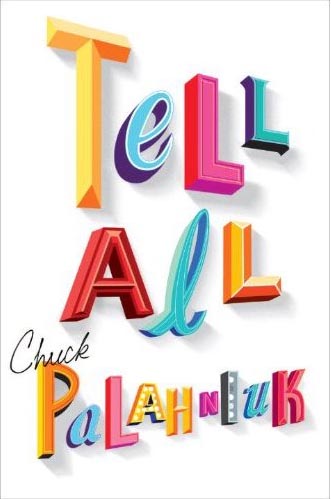
Tell All by Chuck Palahniuk May 27, 2010

Filed under: Book Reviews — NVMP @ 7:55 PM
Tags: ,

A Book Review by Alexander ‘Stigz’ Castiglione

Anyone that knows Chuck knows what to expect when they crack the spine of one of his gritty novels.  They know that they are about to get hit with a hyperbole-soaked, loathing-enriched story that’s high in distaste for the human condition and low in moral fiber.  This piece is no different, and its disturbing qualities are only exceeded by its truthfulness, no matter how hard it is to accept.

For the rabid Palahniuk punks, this book is a synthesis of earlier works, like Diary, Survivor, Invisible Monsters, and a few nuances of one of his most offensive pieces (as if everything Chuck writes is not omnisciently offensive and equally unnerving), Snuff. The story is simple: It follows a washed up Hollywood starlet and her personal assistant/savior/guide/maid/confidant.

From a literary standpoint, it is equal with all his other works when it comes to storyline and plot points, however, voracious fans of the nihilistic writer (like myself) will most likely have the whole story figured out by page 70.  However, this book, unlike other pieces by Palahniuk, is unusually short – only weighing in at around 170 pages.  Don’t be mistaken though, it’s dripping with disdain and laced with equally lovable and loathsome characters throughout.

With this particular book, I cannot really say much without giving away the plot, but do yourself a favor and read it!  It’s not a hard read like Pygmy, his previous release, and film buffs will love the name dropping that he subtly ties into the subtext.  He comments on film legends like John Ford and DeMille, but also draws light on the lesser known tragedies of the silver-screen starlets in true Chuck fashion.  Like every other book, you will be full of useless knowledge and disturbing factoids about the world’s most timeless and well known faces and behind-the-scenes geniuses. From Bogart to Hitchcock to Minelli, no name is safe and no star in the sky of Old Hollywood is given refuge.  He bares his literary teeth, and bites the ass of America’s favorite past-time: Sitting back and watching someone else live their ideal life.  Like I said, this is pure Chuck, however brief the novel and nobody is safe.

Like his other work, he continues to find new and interesting narrative devices to separate him from the rest of the post-modern, post-anything writers that live on the shelves of bookstores worldwide.  Just like his journalist in Lullaby using the newspaper ads to tell us something or via the false medical diagnosis in Choke, he writes through the eyes of Hazie, who is writing her screenplay as we read the book.  In this particular piece, he indirectly calls out the cancer of name-dropping and brand name subservience that, more and more in today’s fast paced world, everybody is contracting.  I don’t want to ruin it, but by page six, you will have heard enough about this actor or that director, this face cream or that designer purse.  And he lays it on thick, as always, to really have you thinking outside of the standard framework of modern decadence and look at the absurdity of it all.

Rabid Chuck fans: Go out now and get a first edition!  Newcomers to the poet Palahniuk: read his earlier stuff and then devour this: you will not be disappointed.


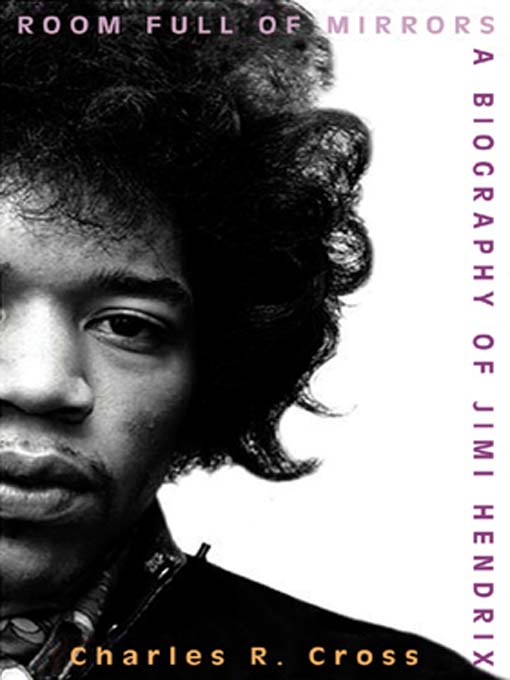
Room Full of Mirrors: A Biography of Jimi Hendrix by Charles R. Cross May 5, 2010

A review by: Alexander “Stigz” Castiglione

When you hear the name “Jimi Hendrix,” a lot of words pop into mind.

Rock Legend.  Guitar-God.  Iconic figure of the Peace & Love movement.  Poet.  Pauper.  Druggie.  Fashionista.

But after reading this book, it’s easy to see that these words and phrases only scratch the surface of the enigmatic and magnetic man that was James Hendrix.

Following a meteoric rise to fame in less than a decade, this burning star was extinguished at the young age of 27.  Ironically and tragically, the same age Jim Morrison, Janis Joplin, and Kurt Cobain were when they died.

Being a huge fan of Jimi since I was a kid, there are a lot of items in this book I found interesting, some parts were inspiring while other parts were abhorrent.  The first hundred pages or so are the latter, illustrating his underprivileged and unstable childhood in the Northwest.  With the volatility of alcoholic parents and poverty surrounding him, Jimi never had it easy.  Most people don’t know that Jimi escaped this by going into the Army.  Or rather, he was given a “choice:” go to jail for joyriding in a stolen car, or go into the service.  He opted for the service and soon figured a way to make it out of the Army (which I’ll let you read to find out).  Most people don’t know about his drug bust in Canada, or how exactly The Jimi Hendrix Experience was formed.  This book answers all these enigmas and then some.

A Room Full Of Mirrors is a splendid synthesis of hundreds of interviews with family and friends, clips from music journals, and even some letters he wrote to his family.  Rarely does a biography make you feel like you know the person.  Not just the where’s and when’s of a life, but the how this person really was—their quirks, fears, mannerisms and eccentricities.  In that respect, Cross is a genius, as many of his anecdotes make you feel like your right there with Jimi.  From he and bassist Noel Redding being confused for clowns in an English pub, to Jimi partying with Leonard Nemoy- Yes, Leonard Nemoy—Spock from Star Trek, we get a feel for who Jimi was as a person.  All the way from his naïve early days playing back-up guitar for Little Richard to his overnight success in England, we are with Jimi on his entire struggle for fame and recognition.  Despite his antics on stage with blazing Stratocasters and epic guitar solos, he actually was an extremely shy man-something many pieces leave out.  From his voracious sexual appetite and phone-book size list of conquests to his professions to his Aunt Delores about his disgust with fame and the limelight, every facet of his persona is fleshed out in under 400 pages.

What I really like about the book is the fact that Jimi’s prolific drug use isn’t played up and sensationalized like other pieces, but rather Cross aims to take us into Jimi’s mind.  Within this “room full of mirrors” we see how Jimi viewed himself, cared for his family and lived like every day was his last.  From his stellar performance at Woodstock (where he subsequently collapsed from exhaustion after leaving the stage, since he had been up for 3 days straight), to being booed offstage early in his career on the Chitlin’ Circuit, this book doesn’t highlight the controversial and leave out the mundane.  It covers everything, going back to his father’s father in the first few pages.  The family history part of the book is rather dull at points, but vital to understanding most of the story in the long run.  In many ways, the novel pays homage to the notion that you can’t know where you’re going if you don’t know where you’ve been.

I could go on for days saying how intriguing and timeless Jimi’s life was and how tragic his death was in the end, but I figured I’d give you a few facts I walked away from the book with.  Most people don’t know this, but Jimi is probably one of the most interconnected and dynamic people to come out of the music industry.  He earned the love and respect of Eric Clapton and Cream, while literally having them scared shitless of playing a show with him for fear of being upstaged.  The same sentiment was held by Mick Jagger and the Stones.  Jimi also tried to date Keith Richards’ girlfriend, and the two legends almost had it out one night.  He even, in a monumentally ballsy move, played his own covers from The Beatles Sgt. Pepper’s Lonely Hearts Club Band album with Lennon and McCartney in the crowd at the Monterey Music Festival only a few days after the album was released.  McCartney came up to him and told him how solid his take on the song was.  Even the legendary Bob Dylan loved Jimi’s rendition on “All Along The Watchtower,” and it is extremely hard for musicians to give credit to another musician for playing a cover.  In a few short years, Jimi went from wearing loud, sequin suits behind Little Richard, to headlining Woodstock and being the highest paid musician in the world.  And yes, boys and girls, Jimi’s junk was cast in plaster long before any other rock star, kick-starting the rock star debauchery way before Mötley Crüe was on the scene.  And the biggest shock of all: Lemmy of Motorhead was a roadie for Hendrix at one point.  Yes, Lemmy Kilmister used to haul Jimi’s gear.

Another interesting tidbit: Janis Joplin and Jimi were rumored to have banged it out at the Fillmore.  And, even more badass, while Jim Morrison was heckling Jimi one night in the Village, Joplin smashed a bottle of Jack Daniel’s over The Doors front-man’s head.  The raging irony is that these three superstars and brilliant musicians all ended up dying within a year of each other.

For the casual Hendrix fan, this book may not be a good choice, as it really gets detailed and in-depth, even mundane at some points.  But for anyone who loves the music, culture, and times from when Jimi (and his contemporaries like Clapton, Jagger, Joplin, Lennon, McCartney and Morrison) came, you will absolutely devour this book.  Cross paints a picture so clear, so unique, so detailed, that you feel as if you knew the Voodoo Child himself.  From his rowdy early years as a child to his stint in the army to his stellar rise to the top of all things musical, this book leaves no stone unturned, no detail unmentioned, and no room for anything but awe of this brilliant man’s tragically short life.


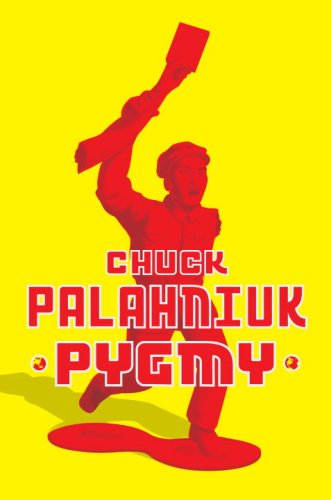
Pygmy by Chuck Palahniuk June 11, 2009

Filed under: Book Reviews — NVMP @ 4:14 PM
Tags: ,

by Alexander Castiglione aka STIGZ

Pygmy-by-Chuck-Palahniuk-Books__41w5KNtGdML


     Take a bowl. Now throw in some violence, a little sodomy, a dash of drug use, absolute degradation, and a hint of nihilism. Then take a spoon, and mix it together. Now you have any novel by Chuck Palahniuk. His newest satire, Pygmy, is no different.

       In comparison to his other works, the book still screams Chuck, but it has subtle nuances that make it different from his earlier work. This deliciously degrading and delightfully disgusting satire of American society paints a picture of American society from the view of an outsider.

     The outsider: A pygmy from nameless communist/fundamentalist/anti-American nation X, and he takes us on a first person account of the decadence of American culture. During these adventures his goal is to solidify a plot to destroy America, aka Operation Havoc. This should sound vaguely familiar for Fight Club fans.

      Actually though, this piece is vastly different from his early endeavors, like Fight Club or Choke, as it is told in “Pygmy-speak,” a language devoid of prepositions, verb tense, or even articles. This makes it slightly harder to speed through than other prose, as you have to stop and decode what he means, however, it is spectacularly written because he keeps this tone throughout the book. This only furthers his effectiveness in his sarcastic assault on our society, as it makes the reader look at life from outside our own air conditioned, high-def, and made-to-order American comfort zone.

      Lines like “Ancient sentinel rest gray cloud eye upon operative me, roll eye from hair and down this agent, say, ‘Welcome to Wal-Mart.” Say, ‘May I Help you find something?’” make this book hard to read at first, but soon the pages turn, and the satiric sarcasm drips from the pages. Soon you’ll be reading quotes from some of history’s undesirables like Marx, Hitler and Mussolini, rattled off by the narrator. The frightening part: some of the quotes make great insight, and would be widely used if it wasn’t for their monstrous authors. For example “War is to man what maternity is to women,” or “He alone, who owns the youth, gains the future.” Trust me, you’ll be scratching your head saying “Well I guess he wasn’t that crazy.”

      As with every other Palahniuk masterpiece, there are no holds barred and nothing is sacred. Religion is under fire, consumerism and corporate influence on the chopping block, sexuality and pornography are thrown in your face, and the dysfunctional family portrait is painted; all the while making you feel like you’ve been beat to a literary pulp.

      From the Pygmy’s porn addicted brother to the masturbation addicted parents to the pedophilic preacher, not one character in this book is safe, nor is one group of American society. I would call this the best example of “Anti-Americana” we’ve seen since Vonnegut. However, you have to take Kurt, hit him with some steroids, a little acid, and a whole lot of disdain for the “culture of us,” throw in some Pygmy speak, and you have this novel.

      Don’t worry, Chuck fans, this book still gets into the deep seated and horribly accurate truths of life. There’s violence teeming from the every chapter, with made up kung fu moves, like “striking cobra quick kill,” and “flying giant stork death kick,” but also jabs at every institution and practice. He batters the overmedication of society, from Xanax to Ritalin, he harps on prolific drug use of teens, and rips the media a new one. The really scary part? The picture he paints isn’t that far from the truth.

      If you love Chuck, you’ll love this book. A hard read at first, but make no mistake, this book gets as dirty and gritty as everything before, and will no doubt have you second guessing your next trip to a chain store, the next mass you attend or the next prescribed pill you pop.